

THE NEW MOLOTOV-RIBBENTROP PACT, THE REMAINS OF UKRAINE, AND THE NEW EUROPEAN THEATER OF WAR
Durt Fibo
March 25, 2025
On November 8, 2024, Der Koolschrank wrote how World War III was already alight, and that its epicenter was in the USA itself. By Jan 20, 2025 fantastic new threats, scrambling of alliances, and politico-economic attacks were set in motion upon the inauguration of Donald Trump as President of the USA. The weeks since have stunned the world, with his actions –impelled by greed, idiot rage, unparalleled ignorance, or a genuine devotion to adversarial countries- as the war immediately began destroying every nation within reach, including his own. And the world knows, that however atrociously a state treats its own inhabitants, its treatment of others’ will be just as bad, if not worse. The damage is already incalculable.
As the US becomes a concentric prison camp in which neither citizens nor tourists are secure indoors or out, as intoxicated sadists advance corporal punishment for women for any reason –depraved wet dreams or real mishaps- other countries have released torrents of people through their capital streets demanding an end to corrupt, authoritarian and unlivable conditions. Hungary, Slovakia, Romania, and even ultra-patriotic Serbia are ready to collapse and fall towards decency. Americans have not reached this level of awareness or self-preservation any more than the Russians have.
Having already made Hitler look like a rational humanitarian in comparison, Trump’s assaults have horrified all traditional US allies; other nations recoil in disgust. Besides slamming doors shut for normal civil and scientific communication and condemning his own and faraway populations to death by disease and starvation, Der Trump’s avarice and scurrilous affiliations have exacerbated the worst possibilities in places like Gaza and Ukraine, where his personal friends have been wreaking hell. The repercussions of the new American Reich are active dangers to other polities, most immediately Ukraine and the rest of Europe.
Today Der Trump has lain his reverse Midas touch on the Russo-Ukrainian war in what he calls cease fire talks –which is quite a different thing than his 2024 boast that “I will get it [the war] settled before I even become president”. The talks are being hosted by Trump’s golf league/family hedge fund partner Saudi Arabia. Trump dismissed the idea of Ukraine needing any representation there, prompting Zelenskiy to announce Tuesday: “Any country has bilateral relations with other countries; please, discuss whatever you want, but you cannot make decisions without Ukraine on how to end the war in Ukraine, the terms, or other conditions. And we weren’t invited to that Russo-American meeting in Saudi Arabia.” Der Trump sneered back: “I think I have the power to end this war, and I think it’s going very well [sic]. But today I heard, ‘Oh, well, we weren’t invited.’ Well, you’ve been there for three years. You should have never started it. You could have made a deal.”
The fabulation that Ukraine started the war has been a constant running gag in Russian media, as much as the lie that Ukraine never wanted peace. Both these starting-holes were seriously repeated by the American rubes who voted in and are now partially administering Der Trump’s Reich. Concomitant with that illusion was a myth that Zelenskiy himself was ever the obstacle to peace negotiations. On the contrary: from the first opportunity –one week after Russia attacked- through the next 30 days, he agreed to no less than four peace talks. Looking through Der Koolschrank’s original live coverage of the war, we see that, oddly enough, Putin had requested the first such talks on February 27 (actually he’d forced Lukashenko to ‘host’ them right on the Belarus-Ukraine border). Zelenskiy agreed without preconditions, but advised his country not to expect any miraculous conversions to rationality among the Russian negotiators. However, he explained that he was sending his team so that “no citizen of Ukraine would have any doubt that I, as president, tried to stop the war when there was even a chance.” Talks finally took place at a secure location in Gomel on February 28, stalled until noon of March 1, and lasted six hours. As Kyiv continued to endure bombings, Zelenskiy said from the capital that his aims were for “an immediate ceasefire and the withdrawal of troops from Ukraine.” Both delegations returned home to “consult” in preparation for a second promised round of talks either “at the earliest possible opportunity” or “within days.”
On March 3 the Ukrainian delegation was near Brest, on the Belarus/Polish/Ukraine border for a second peace talk with Russia, where the parties agreed on “humanitarian corridors for civilian evacuations and exoduses as well as incoming food, medical and similarly classed supplies”. The delegations also announced temporary ceasefire zones. On March 5, the Ukraine government was frantically making use of the single-day timeframe for the “humanitarian corridor” agreed upon to evacuate as many civilians as possible from Mariupol and Volnovakha. This same day, Zelenskiy proposed further peace negotiations for as soon as March 7. In Moscow, Turkish President Recep Erdoğan, was meeting with Putin and had already personally delivered a message to him from Zelenskiy reaffirming Zelenskiy’s willingness to hold direct negotiations with Putin. Meanwhile, the day’s humanitarian evacuation process was continually violated by Russian attacks on the evacuees.
By March 7, no time nor location for talks had been publicly confirmed. But, in Moscow, Vladimir Putin’s own press secretary Dmitri Peskov announced that a mere total of 4 conditions would suffice to fully placate Russia, at which point “All this can be stopped in a moment.” Moscow’s demands were: Ukraine cease military action, change its constitution to enshrine neutrality (i.e., “to reject any aims to enter any bloc.”), acknowledge Crimea as Russian territory, and recognize the separatist republics of Donetsk and Luhansk as independent states. The International Committee of the Red Cross pointed out that besieged Mariupol (still the scrawniest point in the Russified eastern corridor) was unable to evacuate civilians despite attempts on the 5 and 6th -as directed by Russia- because “the road that was indicated to them was actually mined.”
On March 10, Talks sponsored in in Antalya, Turkey, ended with no agreements about anything. Yet much was amiss: Putin mouthpiece Dmitry Peskov had said Ukraine needed to meet 4 conditions and then “All this can be stopped in a moment.” Zelenskiy had already indicated his leaning towards recognition of Donetsk and Luhansk independence as well as keeping Ukraine out of NATO. That left only two unmet: that Crimea be acknowledged as Russian territory, and that Ukraine cease military action. The former Zelenskiy could probably get the Rada (Parliament) to concede, since it is more or less in line with his words on Donets/Luhansk. The ultimate — Ukraine ceasing military action– could only happen if split-second timing arrangements were made and adhered to, as in every known case of a country or cause laying down arms in a genuine peace arrangement. The delay indicated a hidden 5th concession must’ve been added to Russia’s list.
On March 15, Ukraine/Russia peace talks resumed following a “technical pause”. They continued through the 16 and ended with far more confusion than they began with. Russia’s previous 4 simple demands had clusterbombed into a 15-point Russian “draft”. Mykhailo Poldolyak, adviser to the head of the President’s Office, insisted that “The data on a draft treaty between Ukraine and Russia…reflect only Russian demands…The only thing we confirm [for a Ukrainian draft] at this stage is a ceasefire, withdrawal of Russian troops and security guarantees from a number of countries.”
On March 21, Peskov yawned and declared that “Progress seen in negotiations between Russia and Ukraine is not sufficient thus far to discuss direct contacts between Russian President Vladimir Putin and Ukrainian President Volodymyr Zelenskiy.”
By March 25 Turkish President Erdogan claimed his efforts brought Ukraine and Russia closer than ever to practical agreement on Putin’s “four demands”, which he now accidentally adduced as six. Minister of Foreign Affairs Dmytro Kuleba brushed the claim away in disgust; even the number of “points” (in his words) is a fantasy.
On March 29, the “The Istanbul Communiqué” postulated nonaligned status for Ukraine, discussion of autonomous status for the DNR and LNR, postponing the Crimea issue for a number of years and continued negotiations on the size of the Ukrainian army with delegates actually authorized to sign agreements –credentials Putin had continually neglected for his representatives.
Any pretense of furthering peace talks in good faith then ceased with the on-site discovery of the Bucha massacre –on the left bank of Kyiv- at the beginning of April. Zelenskiy had been out seeing the effects on his people since the beginning, from the first, as well as at Bucha; the shock and grief on his face was not acting; unlike his self-appointed enemy in the Kremlin, he was not accustomed to death as a way of life.
After that, the war cycled around, with great enough Ukrainian victories in the Kharkiv and Kherson regions to convince many in Moscow that Russia was staring at a military collapse, until Putin ordered up a mass mobilization. Other countries either grumbled and suffered, or slid in to gain what they could from a long proxy war. There was a 2-day breakthrough in which a deal was arranged and ‘guaranteed’ by both the UN and Turkey to allow Ukraine to ship out some 25 million tons of wheat and grains –much of it destined for Africa- at risk of rotting in Ukrainian ports due to Russian blockades and assaults. That deal was demolished the next day (July 23, 2022) by Russia blasting Odessa’s port with Kaliber missiles.
During the 3 years of Russia’s continued war, Europe created yet more ‘austerity’ measures to keep from freezing, survived constant cyberattacks perpetrated by Russia, and saw its most racialist political parties amplify their voices and votes, backed by Russian money. On the far end of the ocean, America witnessed around one third of its media and voter base charging into the same anti-Ukrainian fervor. In the Hague, Vladimir Putin was indicted as a war criminal and, in Moscow, Dmitry Medvedev called for Zelenskiy’s assassination.
________________________________________________________
Between the dissolution of the USSR and 2019, Ukraine had pingponged between rulers devoted to Putin’s Russia and others inclined towards a European-style state, with various Presidents reneging on campaign stances and some using subterfuge or force to realign with Russia. After two mass uprisings against such politicians, having run on an anti-corruption platform at the head of the Слуга народу (Servant of the People) Party, Zelenskiy was elected president in 2019 with 73% percent of the national vote to the incumbent Poroshenko’s 25%. As an historic quiddity, Zelenskiy also proposed measures to better unify –or at least ameliorate antagonisms between- the pro-Russian and pro Ukraine population groupings.
Best known to the West as a comedian, Zelenskiy’s larger achievements were as a producer, of his comedy troup, Kvartal 95, and this experience was probably vital to his and his country’s survival in war time. He knew how to get things done without fail and on time; how to delegate hundreds of tasks –each one indispensable- and maintain the ongoing process and final aim in all its particulars and end-results in mind throughout however long it took; and how to get financial backing for the production.
The opening period of the Russian war on Ukraine was met with shock and paralysis by the rest of the world –particularly Europe, which should’ve been the first to react coherently- for the unexpected political and military throwback of Russia’s tactics most directly, but also for two causes which brought about a moral refocusing. Primarily it was simply the questioning of whether Ukraine would endure beyond the initial few days or months, and thus whether it was worth investing any money or equipment in its countermeasures. But –more saliently- there was a window of time around the war’s inception which set Zelenskiy and his people as a grave threat to Europe; restructuring Ukrainian society as a more humanitarian model of European capitalism –redirecting the socioeconomic flow outwards to the public culture rather than inwards to the few- a return to an idealized pre-neoliberal-era ”capitalism with a human face” that would force the rest of the continent to reflect on its obvious and ongoing failings. This was the truly crucial factor in the hesitancy Europe gripped onto during those first desperate months –then years- of the war.
Ukraine was regarded by Europe proper as little more than a Third World stewpot. As in Russia, oligarchy took root during the post-Soviet gang wars of the 1990s, but by the time Yeltsin handed power over to Vladimir Putin in exchange for a mutual non-prosecution and blackmail pact in 1999, the former KGB schemer was on course to terrorize the Russian moneyed class into mute cooperation. Ukraine in that same period appeared untameable.
Yet before the Russian invasion new laws had been passed by the Verkhovna Rada (Parliament) establishing and refining a High Anti-Corruption Court, a National Anti-Corruption Bureau, and the registry of oligarchs: a bill formally titled “On the Prevention of Threats to National Security Related to the Excessive Influence of Persons who have Significant Economic or Political Weight in Public Life”. This last is indeed a required registry based on net worth which imposes on the registrants a ban on financing political parties, participating in the privatization of major companies, and the submission of a special declaration of their income. The registry law was enfolded into the framework of the National Security and Defense Council – along with a registry of Ukrainian companies connected to the Russian oligarchs, who made their fortunes through friendship with the Kremlin and were responsible for Russian aggression against Ukraine. The registry also applied to foreigners.
By 2020, Zelenskiy had acrimoniously pulled away from Ihor Kolomoisky, one of the country’s biggest oligarchs and the owner of 1+1 Media Group, which was then possibly the largest media conglomerates in Ukraine. Before that, Zelenskiy’s production company had been fostered by Kolomoisky, who also appeared to approve of his entry into political life; the oligarch had himself been inevitably involved in Ukrainian politics – having at times supported Viktor Yushchenko, Yulia Tymoshenko, and Vitali Klitschko.
In the last quarter of 2021, the Pandora Papers were leaked to the public, and tucked within them was evidence that revealed that Zelenskiy himself had offshore assets, chiefly derived from TV shows aired on Kolomoisky’s channels. There then began rumors about that offshore operation having holdings in valuable properties, including one asserting that the President’s wife had bought a palace in Crimea which, investigations proved, was no palace, but just a 3-room apartment (cost: $163,893 in April 2013) in a development named after the former Romanov Tsar’s Livadia Palace. All the preceding was used, disabused, and reused endlessly in Russian and Western media to impugn Zelenskiy’s trustworthiness with Western aid –in monetary or munitions form (aid and defensive arms were regularly needed to repulse aggression by the two Russian enclaves).
Roughly three months into the war, Zelenskiy cut relations with another old colleague from his Kvartal 95 days – Ivan Bakanov- removing him from his position as head of the Security Service of Ukraine (SBU). The Kvartal (now as Maltex Multicapital Corp.) profits –initially boosted by their work for Kolomoisky’s 1+1 Media Group- had been offshored by Bakanov. To be frank, nobody earning more than a street vendor during the days of Zelenskiy’s career rise was keeping their money in Ukraine. His own boss’s bank had been declared undercapitalized and appropriated by the state. Although Zelenskiy had studied economics (and law) in university, none of the measures against corruption and oligarchy instated during his primrose days were doctrinal left-wing ideas –they were merely course-corrections, much as had evolved in Western Europe in reaction to the excesses of the Industrial Revolution. But Bakanov’s ejection was part of a larger purge, which included top state prosecutor Iryna Venediktova, and 60 people in both agencies suspected of collaboration in what became Russian-occupied Ukrainian territory. Previously, on March 31, Zelenskiy had fired Serhiy Kryvoruchka, SBU regional head for Kherson, and another SBU general, since the government was dissatisfied with the precipitous fall of southern region of Kherson, in contrast with the capital, and Kyiv was grumbling of “obvious treason” in Kherson.
When the war did arrive, Zelenskiy from the very beginning called for peace talks, continued almost daily to repeat the offer, as he daily plead with his supposed allies and ‘guarantors’ for air cover. In his eyes one could see that his paramount duty was to save lives. Any life. One saw at the same time how that lowliest position elevated him to the wartime leader who pulled together wildly diverse and antagonistic groupings to save lives, one at a time if necessary, or be pulverized together. He let verifiable Nazis in the door and said “You want to prove how tough you are? Go here, save that, save them.” -They were dispatched to protecting defenseless citizens, and ended up fighting in the bowels of Mariupol’s Azov steelworks for 3 months, still protecting them, until they felt they’d completed their mission and surrendered to be tormented in Russia.
Contrary to rumors, Zelenskiy did not simply “ignore” warnings of an impending Russian attack, as can be proven by the fact that, even before war burst out, Kyiv, anticipating any Russian moves, had located their air defenses as widely as possible, including some 100 S-300PS SAMs. Again: from day one Zelenskiy had begged for air cover and long-range firepower. For years that aid was denied, delayed, diverted and only occasionally delivered, but with strict conditions attached like anchor chains. That Ukraine had been forewarned at all was due to the slight remorse the West sensed for having set the nation up as a human shield since 1994. –Vagaries of translations in that year’s Budapest Memorandum left Ukraine believing its sovereignty was guaranteed (garanties de sécurité in French, гарантії безпеки in Ukrainian), while others received words of the more limited “security assurances” in Bill Clinton’s English, гарантии безопасности in Russian).
Zelenskiy detailed the flaws in the pre-attack warnings as well as his handling of those days in in an Aug 23, 2022 interview with the Washington Post, saying that if he had alarmed the populace about the Russian invasion in advance, Russia would have captured Ukraine in 3 days. Here is the actual quote, don’t be afraid to read it all:
Z: “When it comes to all warnings or signals from certain partners, here is what I explained to them: If we don’t have enough weapons, it will be difficult for us to fight. We will fight them, that’s for sure. And they don’t want to talk. [Russian President Vladimir Putin] hasn’t been willing to communicate for three years. So I don’t want to listen to this nonsense that Russians are ready to talk, this is nonsense. I clearly explained that. Everything we need is weapons, and if you have the opportunity, force him to sit down at the negotiating table with me. I’d been talking about this specifically, because we believed there will be an invasion. You can’t simply say to me, “Listen, you should start to prepare people now and tell them they need to put away money, they need to store up food.” If we had communicated that — and that is what some people wanted, who I will not name — then I would have been losing $7 billion a month since last October, and at the moment when the Russians did attack, they would have taken us in three days. I’m not saying whose idea it was, but generally, our inner sense was right: If we sow chaos among people before the invasion, the Russians will devour us. Because during chaos, people flee the country. And that’s what happened when the invasion started — we were as strong as we could be. Some of our people left, but most of them stayed here, they fought for their homes. And as cynical as it may sound, those are the people who stopped everything. If that were to happen, in October — God forbid, during the heating season — there would be nothing left. Our government wouldn’t exist, that’s 100 percent sure. Well, forget about us. There would be a political war inside the country, because we would not have held on to $5 billion to $7 billion per month. We did not have serious financial programs. There was a shortage of energy resources in the market created by the Russians. We did not have enough energy resources. We would not have been able to get out of this situation and there would be chaos in the country. But it is one thing when chaos is controlled and it is during a military time — you run the state in a different way. You can open the border, close the border, attack, retreat, defend. You can take control of your infrastructure. And it’s another situation when you do not have a military situation or emergency regime in place, and you have a state that is ruled by a huge number of different officials and institutions. And minus $7 billion a month, even without weapons, is already a big war for our country.
WP: So did you personally believe full-scale war was coming?
Z: Look, how can you believe this? That they will torture people and that this is their goal? No one believed it would be like this. And no one knew it. And now everyone says we warned you, but you warned through general phrases. When we said give us specifics — where will they come from, how many people and so on — they all had as much information as we did. And when I said, “Okay, if they’re coming from here and it’s going to be heavy fighting here, can we get weapons to stop them?” We didn’t get it. Why do I need all these warnings? Why do I need to make our society go crazy? Since February, even from January as there was a lot going on in the media, Ukrainians transferred out more money than Ukrainians abroad received in assistance. Tens of billions of dollars in deposits have been withdrawn, so Ukrainians spent much more money in Europe compared with the amount Ukrainians had been given there, with all due respect. Therefore, you must understand that this is a hybrid war against our state. There was an energy blow, there was a political blow — they stirred the pot here, they wanted a change of power from inside the country, thanks to this party. The third blow was during autumn and a financial one. They needed the exchange rate of our currency to be a wartime one so that we did not have gasoline. So they did all this: There was no fuel, we did not have gas, they were cutting us out to ensure that the heating season would lead to destabilization within the country, and for the people to know there are the risks of currency devaluation so they would withdraw money. In general, they did this so we would stop being a country, and by the time of their invasion, we would have been a rag, not a country. That’s what they were betting on. We did not go for it. Let people discuss in the future whether it was right or not right. But I definitely know and intuitively — we discussed this every day at the National Security and Defense Council, et cetera — I had the feeling that [the Russians] wanted to prepare us for a soft surrender of the country. And that’s scary.”
____________________________________________________
As the war became scored by years, the USA more concretely reinserted itself with its own interests foremost in mind and moves. The war now had more than two players involved: America, the EU, diverse European nations, Iran and its allies, Turkey, China, the Russian and ex-Soviet borderland republics, and, finally North Korea. As many of us had warned all along –including Zelenskiy- this attack would assume a global magnitude.
To serious observers, Vladimir Putin is reckoned as the richest man on Earth. Furthermore, his web of wealth isn’t subject to the whims of one stock exchange or a few brands. As the capo di tutti capi, his horde accumulates from merely sitting atop a pyramidal structure of controlled capitalism and accepting his percentage of whatever crimes pass as commerce in his realm. He is also a life-long KGB manipulator, incessantly calculating and as comfortable with millions of deaths as he is with a back-alley knifing. As Der Trump barges into the scenario, Putin will gleefully be ‘negotiating’ with a man incapable of outwitting a candy bar.
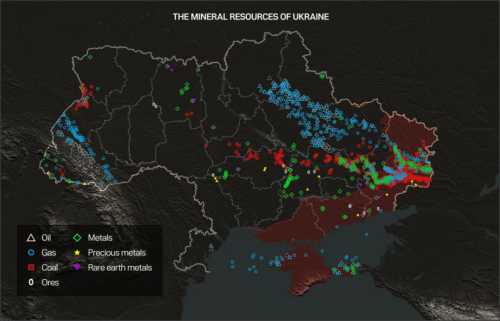
Trump of course, has never forgiven Zelenskiy for his having inadvertently sparked his first impeachment. His ever-vengeful impulses are now leading him to demand a “deal” for the US to haul away at least half of Ukraine’s rare earth minerals, although the resource looting will not stop at that. The extortion attempts thus far also allow for Russia to avail itself of any similar finds on Ukrainian territory it is occupying, and Der Trump further made a point of insisting that no safety assurances or guarantees for Ukraine as a nation will be included. Somehow Trump figured that these assets will go to repay money which was never in the form of loans, while generating future profits to boot. This is known in diplomatic parlance as imposing reparation charges on the victim.
After three years of brute warfare, no human being would emerge the same as they were before, and Zelenskiy cannot be some magic exception. But his central purpose continues on, as he tries to keep Ukraine alive, tries to limit the destruction Trump concocts, tries to smile and flatter him into a position of bedlamite hero.
In the March 11, 2025 phone call between Der Trump and Putin, the latter added a fresh precondition: that the US and its (or, rather, Ukraine’s) allies end all intelligence and military assistance to Ukraine (a “complete cessation” per the Kremlin “of foreign military and intelligence” to Kyiv) in order for hostilities to end. For the present, all the White House could announce was a 30-day ceasefire against Ukrainian infrastructure –which Russia violated less than an hour after the call. Thus encouraged, Trump called Zelenskiy the next day and suggested that the United States take over all four of Ukraine’s nuclear power plants –while still refusing any form of security assurances- even though one of them is occupied by Russian forces. In fact, all Putin’s demands will be accommodated; witness the state of America.
Both emperors share similarities of the worst nature, foremost of which is mythomania. Both are natural-born losers with delusional confidence –which is a mephitic mix when one sees the world as something to steal. Consciously or not, Putin has always used his slowness as an advantage –his ideas rarely work, so he plays for time. Trump, on the other hand, whether Russian agent, asset or immoral stooge, is compelled by pulsating hatreds and cupidity, which will accelerate Putin’s own schemes.
At home, Der Trump has built an American Nazi movement, legislative party and scorched-nation administration sworn to his own Führereid (Führer Oath). Abroad, he has sent out old real estate cronies to conquer new lands and plunder them in the name of ‘development’. Like Putin, he is shredding the formative rules of the United Nations with each passing thought, and threatening the existence of his own legal alliances with every fresh lust. On February 26 of this year he barked that the European Union was formed to “screw” the United States.
Never designed to be anyone’s military adversary, the European Union was indeed created as a bloc to counterbalance the US and Asian economic powerhouses. Integrated as it is in the global markets, by the tail end of the neoliberal venalities, it was bursting with incalculably rich industrialists, hedge funders, asset strippers, schemers, all-and-nothing owners, and political financiers, which, in the ex-Soviet regions were mocked as “oligarchs”.
In February and March of 2022 the situation for Putin was analogous to the First World War in that he risked losing his crown along with his army. Ukraine, however was fighting off WWII-style attacks. Now that Putin has a counterpart since the stumblebum US President has entered the fray, he and his cohorts are likely to trip-launch a Third World war in the same feckless manner that would bring the analogy back to World War One. And, as in those days, the national and international issues are all intermeshed.
New “guarantees” and “assurances” are being launched as the European nations respond to Washington’s alliance with Moscow by sweeping Ukraine to their breasts. US-produced armaments contracts are now being rejected by Europe in favor of their own revivified industry. Military protocols are being drawn up for cooperation between every nation in the EU. Feeling caught in the vice of a Putin-Trump Axis, Poland, Lithuania, Latvia and Estonia are laying down anti-personnel landmines as first lines of defense against the new Molotov-Ribbentrop pact. To the west, their fellow European NATO neighbors are assuming that America itself will be the belligerent who will march in to destroy them. Even Italy’s neo-fascist government has refused official use of US technology (specifically Musk’s), which means that the decision must’ve come down from the intelligence agencies. Very sternly. The Five Eyes grouping has become one gouged orb. Canada is ramping up its military capabilities, speaking of tightening formal guarantees with Europe, and even planning deployment along its southern border. Any US interference or incursion into what it and Russia has made into the European theater of war will blow NATO up in Trump’s face.
Forced by idiot circumstance and Der Trump’s spoon-pounding approach, European existence, society, and finances will be cracked like eggs to be somehow reconfigured. Europe never ceased its weapons industry – Germany and France have long been among the top arms exporters in the world- but with the Trump/Putin axis set on blasting a hole through Ukraine, it will become a major economic force, tugging the continent’s socioeconomic future along with it. The defense industries will consume more of EU countries’ budgets, US and European contractors will settle down for an endless banquet while funds are reduced for social welfare and a new era of austerity measures will whittle down the brittle lives of normal citizens. Now is when Europe will finally be arranged by the Putin-directed worldview, just as –depending on where the lines are walled up- whatever remains of Ukraine will be forced into the conservative strictures of staid European capitalism.